
Updated August 12, 2026
Phuket has done more than hold its position among the world’s premier tropical escapes. It has climbed the ladder, trading volume for value to become one of Asia’s most sophisticated luxury destinations. The question now is less whether the high-end traveler will come, and more how far the island has gone to meet them.
The numbers tell it plainly. Phuket handled roughly 8.8 million passenger arrivals in 2025, and provincial authorities are now openly chasing annual tourism revenue in the region of THB 600 billion, around USD 17 billion.
Just as telling is how that money is being made. Average daily rates across the island rose about five percent year-on-year, with the most exclusive enclaves pushing far harder: Surin lifted rates by more than twenty percent, and the Bangtao and Cherngtalay corridor by roughly the same. Phuket is quietly trading up. The island that once competed on price now competes on refinement, exactly the trajectory we predicted.
A New Cast of Elite Travelers
If there is one thing the past few years have rewritten, it is who the luxury traveler in Phuket now is. The glossy Western celebrity image endures, but the real engine of the high season has shifted.
Our own Phuket villas booking data tells the story more precisely than any island-wide arrivals chart. Three markets consistently lead our villa bookings: India, our domestic Thai guests, and the United Arab Emirates, the last a sign of how powerfully the Gulf has arrived, with Saudi Arabia and Qatar following close behind. Beyond them, discerning travelers from the United States, Singapore, mainland China, and Hong Kong book in real strength, alongside long-loyal guests from the United Kingdom and Australia.
It is a mix drawn less by price than by privacy, service, and the promise of a seamless luxury escape, and one that looks nothing like the package-tour crowds of a decade ago.
The result is a more diverse, more resilient clientele than the island has ever known, and a hospitality scene racing to keep pace with a guest who arrives with global taste and high expectations.
From Rented Villa to Owned Address
Perhaps the most significant evolution is one the casual visitor never sees from the beach. Phuket has become the beating heart of Thailand’s branded-residence boom, a market that now tops THB 205 billion (around USD 6.4 billion) and accounts for roughly a quarter of all such supply across Asia. The world’s most rarefied hospitality names, among them Ritz-Carlton, Rosewood, and Banyan Tree, are no longer merely operating hotels here; they are selling addresses. For the discerning traveler who once flew in for a fortnight in a rented villa, the invitation now is to own a slice of the Andaman outright, with the service standards of a grand hotel attached.
Behind it sits a development pipeline of some 41 hotel and residential projects stretching toward 2030, concentrated in the upper-upscale strip around Bangtao and Cherngtalay. Alongside airport expansion and zoning reform, it marks Phuket’s maturation from a resort-driven island into a genuine, institutional-grade luxury property market.
Beach Clubs Reimagined
The beach club remains the social heartbeat of a Phuket day, but the lineup has been transformed. Where once the conversation centered on a handful of pioneers, a fresh generation now sets the pace.
Rava Beach Club, unveiled by Banyan Tree on Bangtao, stretches an astonishing 150 meters along the sand, billed as the longest in Thailand, with three infinity pools and a grill-and-lounge concept built for the golden hour. In Kata, the elevated Fira Beach Club pairs panoramic Andaman views with fine dining and a sky bar, while Patong’s arrivals, among them Barra Cuda with its dancefloor set inside the pool, bring a bolder, later-night energy. Longstanding favorites such as XANA at Laguna still hold their own, but the island’s day-to-dusk repertoire has never been richer.
The Water Is Still the Point
For all that has changed on land, Phuket’s greatest luxury remains the sea itself. The waters of Phang Nga Bay, with the limestone spires of Koh Tapu, forever “James Bond Island” since The Man with the Golden Gun, still reward those who charter a yacht or catamaran for the day. Multi-million-dollar vessels and private seaplane excursions continue to open up the archipelago’s quieter corners.
One note for the modern traveler: Maya Bay, the cove made famous by The Beach, reopened after a period of ecological rehabilitation and now welcomes visitors under strict caps, with swimming restricted to protect its recovering reef. It is a small emblem of a larger, welcome shift, a Phuket that guards its beauty rather than spends it.
Culture, Craft, and the Long View
Away from the coast, Old Town Phuket endures as the island’s most rewarding afternoon. Its Sino-Portuguese shophouses, now polished, painted, and lined with galleries, ateliers, and design boutiques, offer Asian art, textiles, and craft that reflect a heritage no beach club can replicate. It is the counterweight to the island’s glamour: proof that Phuket’s appeal was never only about infinity pools and DJ sets, but about a place with genuine depth.
And that, in the end, is why the luxury market here was always going to endure. Phuket offers what the truly discerning traveler prizes most: natural splendor, world-class service, cultural texture, and, increasingly, a place worth putting down roots. A decade ago we called it here to stay. Today it is not just staying. It is setting the standard.
Sources
- Passenger arrivals (8.8 million, 2025), average-daily-rate growth (island +5%, Surin +21%, Bangtao +20%), and the 41-project development pipeline to 2030: C9 Hotelworks, Phuket Hotel & Tourism Market Update 2026. c9hotelworks.com
- Tourism revenue target (THB 550 billion / USD 17.3 billion for 2025, up from THB 498 billion in 2024): Phuket Tourist Association (President Thanet Tantipiriyakit), reported by Khaosod English, September 2025. khaosodenglish.com
- Source-market ranking (India, Thailand, United Arab Emirates and others): The Luxury Signature proprietary Phuket villa booking records, 2025 and 2026 year-to-date. First-party data.
- Branded-residence market size (THB 205 billion / USD 6.4 billion; roughly a quarter of Asia’s launched supply): Siam Real Estate, Thailand Branded Residences Market 2026. siamrealestate.com
- Branded residences operating in Phuket: The Ritz-Carlton Phuket, per Asset World Corporation and Marriott International (assetworldcorp-th.com); Rosewood Residences Kamala, per Rosewood Hotels & Resorts (rosewoodhotels.com); Banyan Tree at Laguna Phuket.
- New beach clubs (Rava, Fira, Barra Cuda): Phuket Insider. phuket-insider.com
- Maya Bay reopening, visitor caps and swimming restrictions: CNN Travel. cnn.com
Villa collections and private-charter arrangements across Phuket are available through The Luxury Signature.
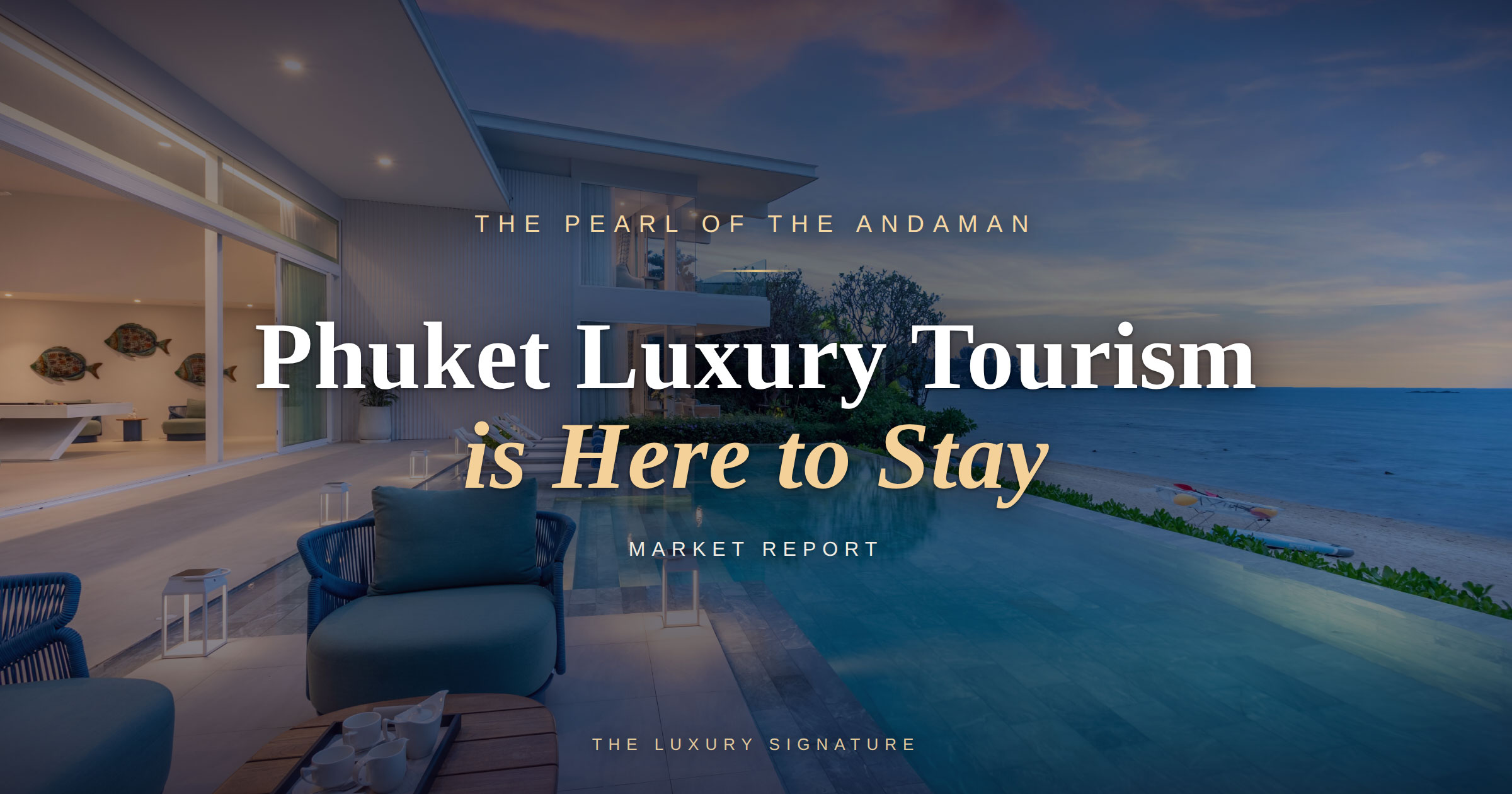
Featured image: Villa Amarapura, Cape Yamu, Phuket

Darrel Bella is the Founder / Managing Partner of The Luxury Signature and leads its team with a brand-builder’s eye and a traveler’s heart. A marketer by trade, he’s spent his career shaping experiences worth remembering. When he’s not working: quality time with loved ones, a good book, or a racquet in hand.